Follow us on:

Royal Funeral of Cremation Day of King Father Preah Norodom Sihanouk:


Funeral Procession of King Father Body on 1-Feb-2013:


Showing posts with label News. Show all posts
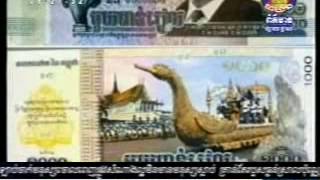
News: New Cambodian Cash Paper 1000Riel Released for Memory of HM King Father Norodom Sihanouk

News: New Cambodian Cash Paper 1000Riel Released for Memory of HM King Father Norodom Sihanouk

National Bank of Cambodia announced on 29 January 2013 for the release for official use of a new paper cash 1000Riel in the Kingdom of Cambodia. The new cash 1000Riel was released in a purpose of remind the memory of all the archives of the activities of His Majesty King Father Norodom Sihanouk that he's a wonderful hero of overall Cambodian people.

Photos: New Cambodian Cash 1000Riel

Watch the videos of the official announcement of the release new paper cash 1000Riel below:


TVK News-30-1-2013-Cambodia National Bank Announcement about new 1000Riel Cash Released


Bayon Morning News-30-1-2013-New Released Cambodian Cash 1000Riel:


News: Cambodian Queen Mother, King thanks China for late King Father's care


King Mother and Premier Wen at Royal Palace

Cambodian Queen Mother, King thanks China for late King Father's care


PHNOM PENH, Nov. 12 (Xinhua) -- Cambodian Queen Mother Norodom Monineath and her son, King Norodom Sihamoni, expressed their profound thanks to Chinese leaders and doctors for taking care of former King Norodom Sihanouk until his death on Oct. 15, according to a royal message released to the media on Monday.

"We'd like to express our deepest gratitude to His Excellency President Hu Jintao, Chinese government, Communist Party of China, and Chinese people for their condolences over the passing away of the King-Father," said a royal letter signed by Queen Mother Norodom Monineath and King Norodom Sihamoni and sent to President Hu Jintao last Thursday.

They also thanked Chinese leaders for arranging a plane to return the King-Father's body from Beijing to Cambodia's Phnom Penh on Oct. 17.

Besides, they expressed gratitude to elite Chinese doctors for providing medical treatment to the King-Father for 42 years until his death.

"We are very satisfied with the friendship relations and cooperation between Cambodia and China and wish to see the ties grow stronger and stronger in the future," they said in the letter. "We will remember forever the great kindnesses of Chinese government and people to the King-Father."

Deceased former King Norodom Sihanouk was the founder of the diplomatic ties between Cambodia and China. The two countries established the ties in 1958.

Sihanouk died of illness at the age of 90 in Beijing on Oct. 15 and his body was returned to Phnom Penh by Air China jumbo jet on Oct. 17.

After a week of mourning, his body has been lying in state for at least 3 months at the Royal Palace for the public to pay their last respects before it is cremated in the first week of February next year.

Sihanouk reigned the country from 1941 to 1955 and again from 1993 until his voluntary abdication on Oct. 7, 2004 in favor of his son, the current King Norodom Sihamoni.

He was the king who led the country to gain independence from France in 1953.

He suffered from various forms of cancer, diabetes and hypertension and had been treated by Chinese doctors in Beijing for years before his death.

Source: Xinhua

News: Cremation of Former King Set for Early February


Body of King Father Norodom Sihanouk at Teveavinichhay temple, Royal Palace, Phnom Penh 20-October-2012

The remains of former king Norodom Sihanouk will be cremated on Feb. 4, ahead of the Chinese New Year, Prime Minister Hun Sen announced Thursday.

Hun Sen spoke at the inauguration of a national road, funded by a loan from China, connecting Kandal province with the Vietnamese border.

There will be no formal or official reception hosted by King Norodom Sihamoni, who is in mourning for his father, Hun Sen said in a speech.

Officials say they expect the ceremony to be attended by millions of people. Hundreds of people continue to gather near the Royal Palace each day, following Sihanouk’s death in Beijing in October.

Some representatives of the government and of civil society will be allowed to pay respects at the Royal Palace, Hun Sen said.

Source: VOA/23-November-2012

Chinese flag flown at half-mast to mourn Norodom Sihanouk


Chinese Flag (Photo/news.ifeng.com)

Chinese flag flown at half-mast to mourn Norodom Sihanouk

The Chinese national flag at Tiananmen Square and Xinhuamen fly at half-mast to mourn the late Cambodian King-Father Norodom Sihanouk on October 17.

Source: Sina

Tradition, Splendor for King Father’s Funeral


Photos: Shirts emblazoned with the image of a young King Father Norodom Sihanouk

Tradition, Splendor for King Father’s Funeral

The funeral of Norodom Sihanouk is set to honor an ancient tradition for Khmer kings based on rituals not put into practice since the last funeral for a Cambodian King took place in 1960.

Officials are planning an elaborate ceremony to be held in the same vein as that of Norodom Suramarit, Norodom Sihanouk’s father, after he had spent just five years on the throne.

Norodom Sihanouk—who died of a heart attack aged 89 on Monday and will lie in state for at least three months—made various public statements about his preferences for how his death should be marked. He once demanded a quiet affair, with a quick cremation. But hundreds of thousands of mourners lining the streets for his return Wednesday made sure his passing would not be low key.

“His last wish about his funeral was to follow the royal tradition,” said the late King Father’s cabinet chief, Prince Sisowath Thomico, admitting that the King Father had been changeable on this issue. “I believe that the protocol in the royal tradition will be followed for this funeral.”

Chea Khean, deputy director of the National Committee for Organizing National and International Festivals, confirmed that the ceremony would be in keeping with the past.

“There is a traditional Buddhist ceremony for the King’s funeral, and it has looked the same from [19th-century] King Ang Duong to King Suramarit,” he said, adding that the committee was currently working out the details of Norodom Sihanouk’s funeral.

Ang Choulean, a professor at the Royal University of Fine Arts’ archeology faculty, said that a Khmer king’s funeral essentially follows the same custom as every Cambodian funeral, but on a much grander scale.

“It’s visible. Everything becomes longer and everything is spectacular,” he said. Going into more detail, Mr. Choulean said the Brahmanist element of Khmer tradition is dominant in the funeral rite—which bears a resemblance to the funerals of Thai royals—but there are influences from Buddhism and animism too.

The body is always kept in state for a number of months, during which prayers are said for the dead king, a period that serves both practical and spiritual purposes, he said.

“You have to make all the preparations. You have to build a special building” on which to cremate the body, he said. “But also, the king needs time. Death is a transformation…. You need to prepare every ritual so you can direct the journey in the right way. You push the destiny in the way you want: All this is the duty of the living.”

To aid this spiritual transformation, the late king’s face is covered with a golden mask, he said. “When you die, you have to change…. You have another individuality, another personality.”

As the date for cremation nears —often after a 100-day ceremony—the body of the late king is placed inside a golden urn, Mr. Choulean said. Prince Thomico said that Norodom Sihanouk’s golden urn was already at the Royal Palace, having been constructed by a team of artisans over a year ago.

Traditional practice, said Mr. Choulean, was for the king’s body to be seated upright in the urn, which is about 3 meters in height, in the fetal position, symbolizing rebirth.

“You put the dead into the position of someone who will be born, someone in their mother’s womb,” he said, adding that the urn is placed at the top of a five-tiered pyramidal pavilion and taken on a procession around Phnom Penh.

In an account published in a 1928 Bulletin de l’Ecole Francaise d’Extreme-Orient, French architect Henri Marchal gives his account of King Sisowath’s cremation in March of that year—some seven months after the king died.

Mr. Marchal described the elaborate procession of the urn in a carriage “made up of three wooden platforms bordered with golden Nagas, supporting the urn.”

“Behind the chariot followed mandarins on horseback, then the women of the palace followed on foot, heads shaven, and dressed in white, decorated with signs of mourning,” he wrote.

Mr. Marchal describes the scene the night before King Sisowath’s cremation, where fireworks and bright lights illuminated the area around the Royal Palace. “The effect is spectacular: with the urn looming in the stream of light, under the folds of the long white drapes, studded with golden stars surrounding the pedestal, a decoration that is in harmony with the funereal lamentations of women….”

A week after the procession, Mr. Marchal writes that King Sisowath’s now decomposing body was taken out of the urn at Veal Mean, the gardens in front of the National Museum, and a funeral pyre created.

The pyre is then lit by the king’s successor. King Sisowath’s ashes were collected the next day from the debris of the pyre and placed in a stupa at Oudong Mountain in Kandal province, according to the account.

Prince Thomico said that some of Norodom Sihanouk’s ashes would be kept in a stupa at the Silver Pagoda inside the grounds of the Royal Palace. But, according to a wish of the King Father, most of the King Father’s ashes will be emptied over the confluence of the Mekong and Tonle Sap rivers, an area known as the Chaktomuk.

Historian Ros Chantrabot said it was also customary to give a deceased king an additional name upon the placing of his ashes in a stupa, as also occurs when a king is crowned. “Kings of Cambodia usually have three or four names that they are given from birth to death,” he said.

Mr. Choulean said he was uncertain whether those making the arrangements for Norodom Sihanouk’s funeral would be able to reproduce the long unpracticed funeral traditions.

However, he said, “This King is immensely revered, so I think that everyone will try to make it an event worthy of him. This King has a certain aura.”

Source: The Cambodia Daily/ 19 October 2012

News: King Sihanouk the Uniter


Photos: King Father Norodom Sihanouk

King Sihanouk the Uniter

An Enduring figure in a country marked by near-constant, often tumultuous, change and perhaps the one person able to consistently create a sense of national unity, the late King Father Norodom Sihanouk leaves behind him questions over where Cambodia is headed following his death.

As king and then prince, Sihanouk ruled his country like a father. Even once that hard power waned, in the hearts of the majority, he remained revered as the country’s last “god-king”.

But with his passing, many wonder about the future influence of the monarchy on Cambodian social and political life.

Political analyst Lao Mong Hay is worried that without a figure who held such “tremendous” moral authority amongst the public to act as a reconciler, the country could become divided.

“I think in our recent history, he is our greatest leader. Regarding his errors of judgment, they are in the past. Look, Lon Nol was nothing, Pol Pot was a disaster for us, even these days our leaders have not been able to unite the country,” he said.

“Without him around, perhaps we will become more and more polarised politically. And there is a risk of politics going extreme.”

Even as re-ascending to the throne in 1993 effectively ended his political ambitions, Sihanouk remained a figure whom Cambodia’s disparate political forces felt they had to both reconcile with and learn from.

“In terms of statecraft or rulership, I think that in Cambodia, he was the master, a great master. I've mentioned this to the King [Father], face-to-face, 'you are just a great guru and everyone should learn from you to learn statecraft or rulership from you.'”

Since Sihanouk abdicated for the second time, there have been concerns that the monarchy would quietly drift out of public relevance under the shadow of increasingly dominant and hostile political forces.

Yet of the masses who turned out Wednesday to pay their final respects as Sihanouk’s body was driven through the streets of Phnom Penh, one constant was the vast number of young people who turned out to mourn a monarch who hadn’t reigned since 2004 or wielded hard power since 1970.

Youk Chhang, director of the Documentation Center of Cambodia, believes the King Father’s passing will revitalise interest in the monarchy and serve to strengthen the moral fibre of the country as the public unites in paying their respects.

“I think we can look at it in a different way than as a weakness, but as a strength, as a respect, as a restoring of culture,” he said.

“This is something that perhaps others have failed to look at or failed to understand, that we also have the role to restore, because a lot of damage has been done by war and genocide and what King Sihamoni has done is to show respect to the father.”

In years to come, said Youk, young people will remember the momentous historical event they witnessed when the King Father’s body was repatriated, and reflect on how Sihanouk contended with the near-constant struggles that confronted him throughout his life.

Youk also said that King Norodom Sihamoni, who is perceived as a far more passive monarch than his father, should be spared unfair comparisons to Sihanouk and accepted as a king that has to develop his own, unique way of reigning.

Political analyst Son Soubert, who is also an adviser to King Sihamoni, said it remains to be seen whether the King will take a stronger and more vocal role in Cambodia’s political affairs now that his father has passed, but, regardless of the path he chooses, he does not expect the country to become more polarised.

Soubert did not expect the passing of Sihanouk to radically change the way people thought of the Kingdom’s monarchy, either by sparking a royal revival or causing a feeling of disconnection from the palace.

“I don’t think people have lost any interest in the [monarchy]. We saw that in the crowds of people in the street,” he said.

Source: Phnompenhpost/19 October 2012

News: China, Cambodia agree to further advance ties

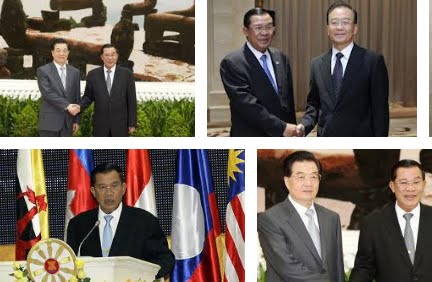
Photos: PM Hun Sen with China


China, Cambodia agree to further advance ties

PHNOM PENH, Oct. 18 (Xinhua) -- China and Cambodia agreed on Thursday to further advance their comprehensive relations of strategic cooperation and partnership in accordance with the will of late Cambodian King-Father Norodom Sihanouk.

Cambodian Prime Minister Hun Sen told visiting Chinese State Councillor Dai Bingguo on Thursday morning that Cambodia "will firmly adhere to a friendly policy toward China and push the comprehensive relations of strategic cooperation and partnership between the two countries up to a new high along with China."

Dai arrived here on Wednesday afternoon for escorting the coffin of Sihanouk back home.

Hun thanked China's meticulous arrangements for Sihanouk. "China's care for King-Father Sihanouk during the past years has erected a monument of Cambodia-China friendship in the hearts of the Cambodian people," he said.

He also told Dai that Cambodia attaches importance to cooperation with China on regional and multilateral affairs. Cambodia will host a series of meetings of East Asian leaders next month. "Cambodia is willing to work closely with China for the success of the meetings," he said.

Dai again expressed condolences and sympathy over the death of King-Father Sihanouk, commending the late king as "a great friend of the Chinese people."h He said the Chinese people will firmly stand side by side with the Cambodian people and believes that the Cambodian people can build up a better country by inheriting King-Father Sihanouk's will.

He also spoke highly of the mutual trust, mutual support and earnest assistance between the two countries.

China supports Cambodia in hosting the East Asian leaders' meetings next month and will work together with Cambodia to make sure that the meetings, featuring solidarity, cooperation and development, will promote regional peace, stability and prosperity, he said.

Dai also met with Cambodian Deputy Prime Minister and Foreign Minister Hor Nam Hong and exchanged views with him on bilateral ties and regional issues of mutual interests.

Source: Xinhua/2012-10-18

News: King Father Norodom Sihanouk passed away

Photos: King Father Norodom Sihanouk


King Father Norodom Sihanouk passed away

King Father Norodom Sihanouk passed away today in Beijing at the age of 89, 59 years after he declared Cambodia's independence from France.

Sihanouk was a greatly charismatic leader revered as something of a God King during the height of his power in the 1950s and 60s. He served both as King and then Prime Minister after taking the daring step of abdicating from the throne to enter politics.

In 1970, he was ousted as Prime Minister in a bloodless coup d'etat led by the right-wing general Lon Nol and watched from exile in China as Cambodia slid further into the turmoil of the Vietnam War that preceded the genocidal Khmer Rouge regime.

The prince returned to his country after it fell in 1975 to the ultra-maoist Khmer Rouge regime responsible for the deaths of an estimated 1.8 million Cambodians, torture, rape, forced labour camps, starvation and the decimation of the country's economy and was placed under house arrest. Several of his children and grandchildren were killed by the regime.

As Cambodia began to recover after the Vietnamese-backed guerrillas liberated the country from the Khmer Rouge in 1979, Sihanouk once again entered into the political fray but was unable to negotiate his way back to the ruler, finally abdicating the throne in 2004 to his son, Norodom Sihamoni.

In recent years the retired King repeatedly travelled to Beijing to receive medical treatment for a number of ailments including diabetes and cancer. In a hospital there, he finally succumbed to a heart attack on today at 1.20 am, Phnom Penh time, Council of Ministers spokesman Phay Siphan confirmed.

Just as Sihanouk was loved by many in the countryside, he was at times loathed by enemies on both sides of politics and was a controversial statesman credited both with great achievements such as helping secure independence from colonialism and catastrophes such as his disingenuous public endorsement of the Khmer Rouge.

A crowd of hundreds if not thousands flocked to the royal palace to mourn the passing of the beloved former King today.

Sihanouk's long-time personnel assistant Prince Sisowath Thomico said King Norodom Sihamoni, Prime Minister Hun Sen, Interior Minister Sar Kheng and Defense Minister Tea Banh travelled to Beijing this morning to retrieve the body and will return Wednesday.

“The whole Cambodian people, the royal family, is just mourning,” he said, adding that the royal palace would issue an official statement soon and that the King Father's body would be exhibited for three months at the palace before the funeral, following royal tradition.

A national week of mourning will begin on Wednesday, Information Minister Khieu Kanharith said today.

Source: Phnompenhpost/15 October 2012

Related Posts Plugin for WordPress, Blogger...